A hazardous area atmosphere zone plan is a site-specific drawing that shows where flammable gas or vapour may be present and where special precautions may apply. Rifft Solutions prepares these plans for businesses working towards Location Compliance Certification, updating an existing site layout, or documenting changes before a compliance review.
In New Zealand, regulation 10.6 of the Health and Safety at Work (Hazardous Substances) Regulations 2017 requires a PCBU using specified flammable gases or liquids to establish a hazardous area when the relevant threshold conditions are met. The regulation refers to AS/NZS 60079.10.1:2009, and WorkSafe guidance says the extent of the hazardous area should be reflected in the site plan. A plan supports the wider compliance process; it does not replace a location compliance certificate, risk assessment or the need to manage the actual site safely.
What is shown on a hazardous area atmosphere zone plan?
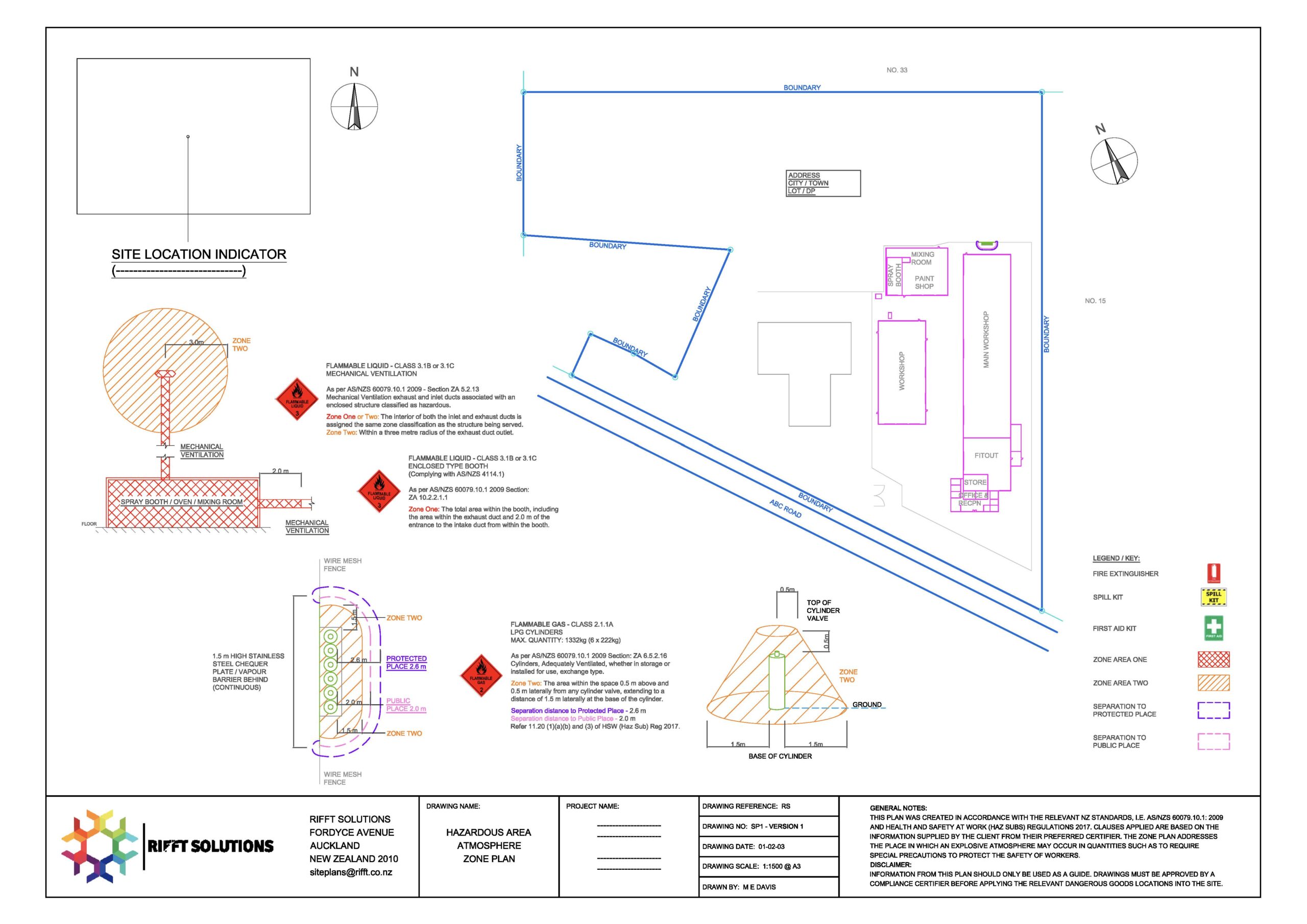
The drawing brings the site layout and hazardous-substance information together in a format that can be reviewed by the business, its compliance team and other competent advisers. The exact content depends on the substances, quantities, release sources and site conditions, but a plan may show:
- the site boundary, north arrow, nearby roads, buildings, access points and other relevant features;
- the location of tanks, cylinders, storage areas, process rooms, transfer points or other potential sources of flammable gas or vapour;
- the extent of hazardous zones and any separation or protected-place distances that need to be understood on the site;
- hazard symbols, safety equipment, a colour or hatch legend, drawing references, revision details and explanatory notes; and
- the assumptions or limitations that help the reader understand what the drawing does—and does not—represent.
What Rifft Solutions can provide
New drawings for a new or changed site
Rifft Solutions’ published service is designed for documentation used in Location Compliance Certification. Its sample plans show how the drawing can be tailored to the source and the surrounding layout, including examples involving LPG cylinders, flammable liquids, buildings, roads and site boundaries. The relevant substance, maximum quantity, storage or handling arrangement, ventilation and nearby places all influence what needs to be shown.
Redrawing and updating an existing plan
An old plan can become difficult to rely on when the site changes or the document no longer matches what is actually installed. Rifft Solutions specifically invites businesses to ask about redrawing or updating an existing site plan before a compliance audit. Its quote form also allows an existing plan to be uploaded for review.
A clear drawing for site discussions
A well-organised plan gives the people reviewing the site a shared visual reference. It can make it easier to discuss the location of hazardous substances, possible release points, separation distances and changes that need to be checked. The drawing should still be reviewed against current site conditions and the advice of the appropriate compliance professional.
When should you review or update a plan?
Arrange a review when the drawing may no longer describe the site accurately. Common triggers include:
- installing, relocating or removing a tank, cylinder cage, dispenser, process vessel or storage area;
- introducing a new flammable gas or liquid, or changing the quantity stored or handled;
- altering buildings, doors, ventilation, accessways, boundaries or nearby protected or public places;
- changing equipment or operations in a way that may affect ignition controls or the location of a potential release; or
- preparing for a location compliance audit when the existing plan is missing, hard to read or out of date.
How to request a hazardous area zone plan
- Gather the current site plan, site address, substance names and classifications, maximum quantities, storage or handling details, and any previous zoning or compliance documentation.
- Use the Rifft Solutions hazardous area atmosphere zone plan service page to request an obligation-free quote. The form accepts comments and an existing site plan can be uploaded if you have one.
- Check the resulting drawing against the current site and coordinate with your compliance certifier or other competent adviser before using it to make safety, equipment or certification decisions.
Rifft Solutions advertises a quick turnaround for site plans, which can be useful when a business needs to bring its documentation up to date before an audit. Timing will depend on the information available and the scope of the site.
What a plan does—and does not—do
A hazardous area atmosphere zone plan is a practical piece of site documentation. It helps communicate where a flammable atmosphere may occur and where special precautions may be needed. It is not, by itself, a location compliance certificate, a complete risk assessment, an operating procedure or a blanket approval for equipment. The final assessment must reflect the current substances, quantities, release sources, ventilation and physical arrangement of the site.
Frequently asked questions
Is a hazardous area atmosphere zone plan the same as a location compliance certificate?
No. The plan is a drawing that documents the site and the hazardous-area information that needs to be understood. A location compliance certificate is issued through the compliance-certification process by an authorised compliance certifier. WorkSafe explains the role of compliance certifiers in its quantity-ratio-sum and location compliance certificate guidance.
Can Rifft Solutions update an existing site plan?
Yes. Rifft Solutions’ service page invites businesses to contact it about redrawing or updating a site plan and provides an optional upload field for an existing plan. Include the latest site information so the update can be checked against what is actually present.
Does every workplace with a flammable product need the same type of plan?
No. The requirements depend on the substance classification, quantity, potential release source, ventilation and site arrangement. Regulation 10.6 includes threshold conditions and a specific exception for low-flashpoint diesel, so the correct approach is to confirm the site’s circumstances with a competent person or compliance certifier.
New Zealand references and next steps
For the regulatory context, read the Health and Safety at Work (Hazardous Substances) Regulations 2017 and WorkSafe’s guidance on hazardous areas and site plans. To discuss a drawing for your workplace, contact Rifft Solutions about a hazardous area atmosphere zone plan and request an obligation-free quote.